


General medicine
Medical assessment for a driver's license
A driver's license medical report documents an assessment aimed at identifying health conditions relevant to safe driving.
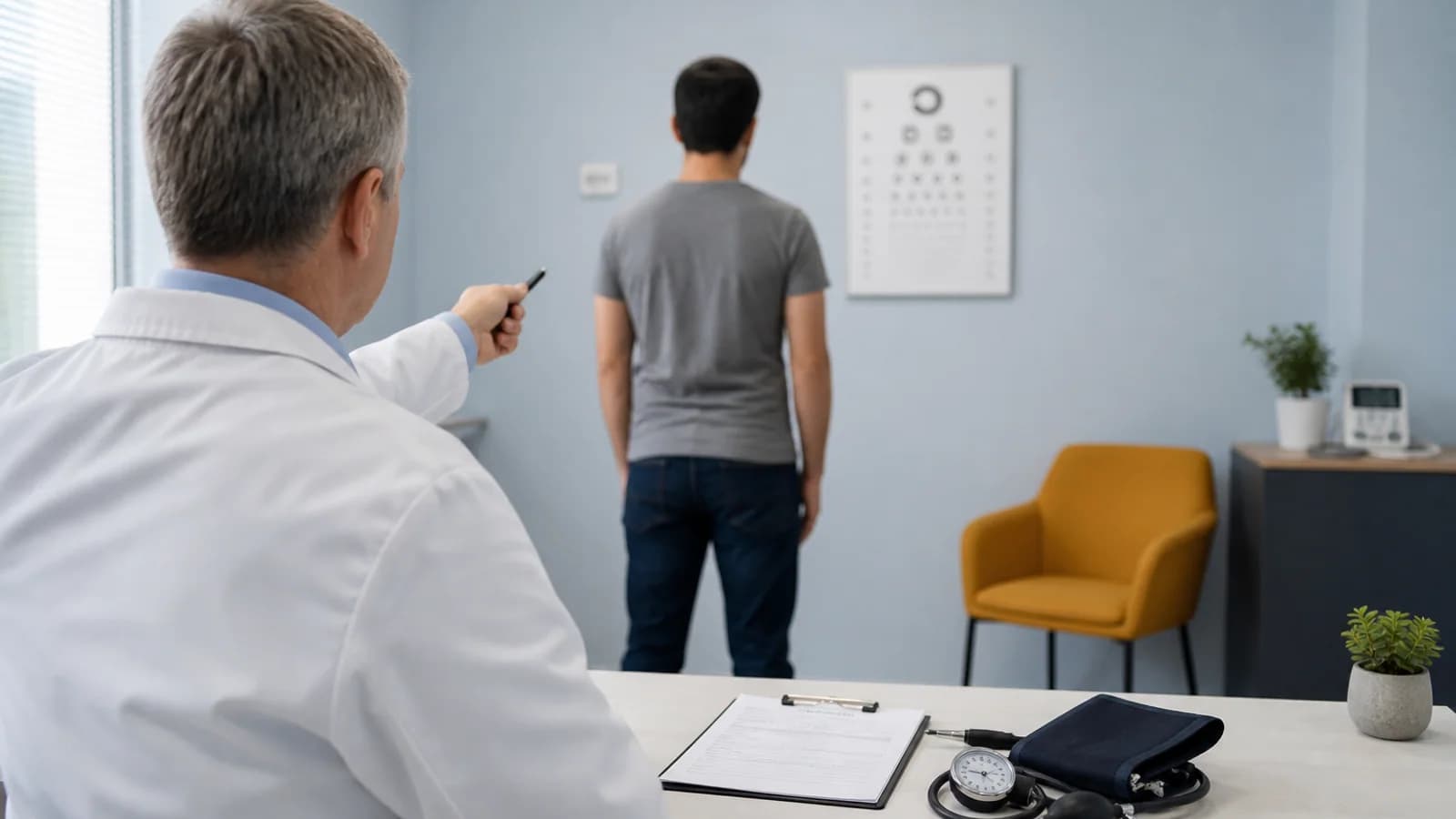
What is the medical opinion?
The Medical Opinion for License is a detailed physical examination requiring the physical exploration, which is the set of maneuvers performed by a doctor, to obtain information about a person's health condition.
During a physical exam, your doctor will study your body to determine whether or not you have a physical problem. Any person is practised in order to recognize the alterations or signs produced by the condition; using the senses and small devices or instruments such as: thermometer, stethoscope, and sphygmomanometer among the most used.
The clinical examination is carried out after a correct history, which consists of a clinical interview, to obtain a series of objective data or clinical signs that are related to the symptoms the patient is referring to. The clinical examination is performed by the patient. The clinical examination is performed by the clinical examination is performed by the clinical examination is performed by the clinical examination is performed by the clinical examination is performed by the clinical examination is performed by the clinical examination of the clinical examination of the clinical examination of the clinical examin.
The information obtained through aamnesis and physical examination is recorded in the file;. and is the basis of an initial clinical trial from which certain complementary examinations are requested or not, which will confirm the medical diagnosis.
Licensing opinion
It starts by requesting the following information: Name and surname, Sex, Date of birth, age, card. Depending on particular or institutional requirements, you may include additional information such as address, telephone, email, marital status, etc.
Physical examination
It should be done in a cerephal-caudal direction (top-down). Considering the different regions of the body. A general inspection of the patient is carried out.
I know I evaluates your state of consciousness, degree of collaboration, mobility, attitude, nutritional status: obesity, toorexia, cachexia. Degree of hydration, vital signs: Temperature, Pulse, Heart rate, Respiratory frequency.
It also includes position and decubitus. March or wander. Face and expression of physionomy. Consciousness and psychic state? Weight and size. Skin and annexes. Lymphatic system. The physical exam should be done in the form of a physical.
- Head: Size, Shape.
- Face: symmetry, involuntary movements, presence of injuries.
- Front: size, symmetry of folds.
- Pararped: blinking, symmetry.
- Eyes: Eyeball, Scleras, Photomotor reflex, eye movements, visual acuity.l.
- Nose: size, nasal mucus, position, nasal mucus, permeability, smell.
- Ears: Audition, Atrial Pavilion, External Conducto Auditivo: hygiene, secretions.
- Mouth: Halitosis, Lips, Amigdalas, Faringe, Deglución.
- The neck: Mobility, Tyroids, Trachea.
- Yugular: caro-pressive pulse, sensitivity, volume increases, mass, stiffness.
- Tórax_: Form, elasticity, expansion, mobility of the chest box, pain, masses, percussion.
- Heart: auscultation cardiac noises.
- Lungs: auscultation lung noises.
- Mamas and Armpits: Symmetry, texture, volume increase, mass presence, retraction, secretions.
- Abdomen: Shape: (flat, distended, buffed, globular). Viseras.
- Espalda: Skin, muscles, bones.
- Dorsal area
- Lumbar area
- Spinal column: Movements, alignment, deformities, vices, sensitivity, curvature.
- Upper and lower extremities: Coloring, pulses, sensitivity, edema, varices, alignment.
- Muscle tone: flaccidity, strongness, atrophy, hypertrophy. Strength and endurance, mobility range.
- Articulations: pain, volume increase, heat, stiffness, deformity.
- Feet and ankles.
Methods of exploration
Inspection (observing body)
It is done through the sight. It is the first step in a physical examination; and is based on the patient's total or partial observation of the body. Its objective is to detect significant physical characteristics of the patient and to observe and discriminate accurately, abnormal findings in relation to normal anatomy. According to:
Region to explore
- Local: inspection by body segments.
- General: conformation inspection, attitude, movement, march, etc.
How it is done
- Direct: It is performed on surfaces or structures accessible to the examiner eye.
- Indirect: Instruments are used to expose internal areas or cavities to the eye.
Degree of mobility
- Static: rest of an organ or body.
- Dynamic: through voluntary and involuntary movements.
Palpation (touching)
It is a method of feeling with your fingers or hands during a physical examination. The doctor touches and feels your body to examine. The size, consistency, texture, location, and sensitivity of an organ or part of the body. His The objective is to detect the presence or absence of masses, pain, temperature, muscle tone and movement. According to:
How it is done
- Direct or immediate: by means of touch and pressure.
- Indirect: using instruments that allow exploring natural or accidental ducts or cavities (probes, catheters).
Pressure level
- Superficial: with gentle pressure for fine tactile results (skin texture, lymphatic gland size).
- Deep: with internal pressure to produce depression and thus perceive deep organs.
Type of exploration_
- Tacto: with 1 or 2 fingers.
- Manual: simple or bimanual.
Auscultation (squealing sounds)
It consists of listening directly or using instruments such as stethoscope, chest area or abdomen; to assess normal or pathological sounds produced in the organs (heart contraction, murmurs).
The most common noises found at pathological level are: rumcus, crepitus, wheezing and sterors. The most common location of the auscultation is: Pulmonary, Cardiaca, Digestiva.
Percussion (producing sounds)
It consists of giving soft taps to parts of the body with fingers, hands or small instruments. It is done to determine the size, consistency and edges of body organs. And Detect the presence or absence of fluid in areas of the body.
The percussion of a part of the human body produces a characteristic sound, depending on the type of tissue that composes the organ. The generated noises are called: Sonroro, Hipersonro, Timpanic, Mate, Water Matidity.
If the consistency of the tissues is compact the sound is matte. If the anatomical structure is in the air, the sound is tympanic. Organs filled with air or fluid are located in body structures such as the abdomen;. and others of solid consistency; which makes it possible to locate different sound tones.
In the lungs, the main content of which is usually air, if condensation occurs in one of its lobes (neumonia), or a large spill develops, a maten noise will be heard over those areas, and not the noise is normal orroroin; Which allows to distinguish, by percussion, a lung from normal or pathological sonority.
- Direct: the blow is applied directly on the surface under examination. Brief and precise blows are made.
- Indirect: A finger is supported, which is called a “pleximeter” on the surface to be examined. With the tip of the middle finger (“percutor finger”) of the other hand short strokes are made and in series of 2 to 3 strokes.
Digital medical opinion
After a good physical check-up, the medical report for leave can be extended, which is a legal medical document aimed at informing the judicial authorities of the health status of the individual.
If you have diseases such as epilepsy, morbid sparrow, some spinal injuries, some traumas (shocks) from accidents; cardiovascular diseases, movement disorders, very advanced age, deep visual disorders, evaporated mental abilities, among others, you will not be able to receive the medical advice for leave?
Additionally, the medical certificate for a license requires special tests for those who are professional drivers such as taxi drivers, bus drivers or special equipment such as chapulines, cranes, back hoes, among others.
Doctors authorized to issue a medical report for a license must know what the vehicle is like for each type of license, its structure and how it performs on the road.
In addition to analyzing the conditions of each patient as chronic diseases, and how these diseases affect the ability to drive, as well as the adaptations that a cart should have for a person with special condition to drive safely.
The licence shall indicate whether the use of lenses, hearing aids, prosthesis, driving limitations is necessary; whether it is possible to drive only during the day, short distances, use only of automatic transmission vehicles, adaptations to the clutch or brake pedal and to the accelerator, hand brake and rearview mirrors, among others.
There are terms of restrictions and adaptations that will determine whether the patient is fit for the license or whether he/she should make adjustments to approve his/her leave application.
Medical opinion for Carthage license
The doctor has the power to recommend that the user be granted leave for a period of less than 6 years, in cases where the opinion determines that the patient presents a condition that limits a future obtaining of the leave decision and therefore, there is a need to perform a physical examination in a shorter time. Doctors may also determine that the patient's assessment must be performed annually, every 2 years or during the period indicated by the patient.
The main objective of a medical report for a licence is to help prevent so much road traffic death and injury. It also contributes secondaryly to detecting diseases or terminal conditions in an individual.
Contact us and our doctors will perform the detailed physical exam so that you get your medical opinion for the license?
Doctors
Dr. Carreel Sevilla Leiva
Dr. José Mena Nájera
Author: Torre Médica Santa Inés
Personalized care
Do you need professional guidance?
Our team can help you find the right specialty and coordinate your appointment.
Schedule via WhatsApp →