


Educational psychology
Effective study techniques
Planning, actively retrieving information and spacing practice are often more useful than rereading for many hours.
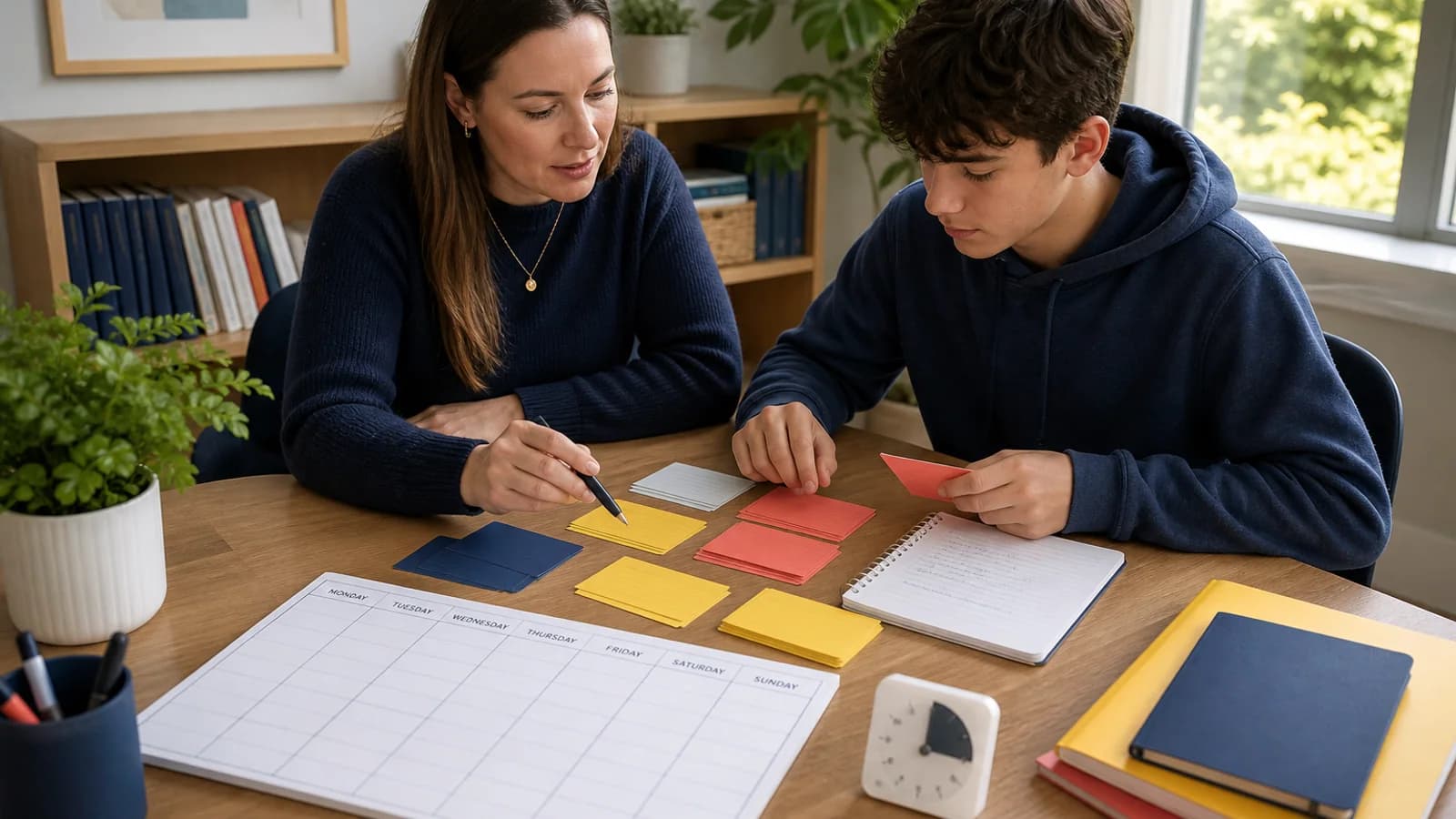
Learn to study with the best techniques of study. If these techniques are not applied, it is likely that it does not seem simple to you, but quite the opposite; difficult, tedious, and even frustrating because your results do not compensate for the effort.
What are study techniques?
The study techniques are. strategies that may vary in a great way according to the educational level (primary, secondary, university) but which ultimately have the same objective, and they seek to accomplish the same purpose that is that the student can obtain better results, from the development of different skills or aptitudes that allow him to better address each activity or task.
These techniques revolve around the notion of order and constancy, of creating habits and a certain regularity that will allow the student to act more quickly and better prepared in relation to certain assigned tasks.
The importance lies in the fact that if you know these techniques and master them, you can study more and better? These methods of study can be applied in all subjects of secondary school and university. They'll be good for your entire academic life.
These are the best study techniques for successful learning
- - I'm sorry.
- Underlined.
- Summary table.
- Conceptual map.
- Mental maps.
How to make a summary
Make your own notes: You know what's your own notes. Sheets / Summary
The use of study sheets is a particularly effective learning method when it comes to absorbing specific data, dates, numbers or vocabulary. Therefore, subjects such as History, Chemistry, Geography or Language are much easier if we include the tiles.
Abstracts are condensed forms of a text, which means the selection of its most important material, and the discarding of everything that is decorative or supplementary.
Steps to make a summary
- Read the full original text: Read the original text: You cannot summarize what is unknown, or read a text above, for you will ignore what are the main ideas and which are secondary.
- Separate the text into paragraphs: The following paragraphs are inserted: The following: The Once separated, mark in each paragraph the main and secondary ideas, using a different highlighter for each category. If necessary, take notes on the sidelines or on a separate sheet.
- Trascribe underlined: Copy the main and secondary ideas into your notebook only, and try to sort them out to form a single paragraph with them.
- Redrafts the paragraph.: Rewrite the paragraph with the primary and secondary ideas ordered, but this time try to do it with your own words.
Underline
The aim is to identify the most important concepts in the text. Ideally, start by doing a general reading of the text. This reading does not have to be paused or accelerated. You must read naturally.
There you will have the first contact with the content and the topics that are presented. The idea of highlighting is to do as little as possible. The more you sub-ray, the less you'll be summarizing and the more you'll have to remember later.
The idea is always to identify a main idea per paragraph. That doesn't mean you should underline it. You need to identify it and then evaluate whether it's really important or not. If it is, you will emphasize it; and if not, no.
Make notes on the margins of the text-is of great help
- Additional Data: Comments to help you understand what the text says
- . Paraphrase of the text phrases: This is useful when there is a lot of technical language.
- Information about the study itself: This is to highlight which parts are included in the exam, or which parts the teacher mentioned in class and aspects of that style.
The idea of the underlined or highlighted is that the text should be highlighted and that the eyes should automatically go to those parts. To do this, it is necessary to emphasize with colors. In this respect, I must say that it is preferable to highlight, since it paints and wraps the concepts, giving them a background of color.
If you prefer, you can use more than one color. Try to keep an order in the colors. That is, use each color to highlight similar aspects of the text. For example, one color for general ideas, another for highlighting definitions and another for punctual data such as dates.
To know if the emphasis has been efficient, after having completed the text, it must be reviewed again. But in this case, just reading what was highlighted. There you will need to pay close attention to determine whether the ideas of the text are represented in what you have highlighted.
Summary table
The simplest and most powerful study technique.
It consists simply of showing the structure of which an idea or concept is composed. They allow a visual expression of an idea by using text and keys.
A keyword or concept can result in a key that functions as a connector to a subdivision or several detachments of the main idea.
This extension, in turn, may be composed of one or more secondary ideas.
The idea is written to the left and it is going to open, always through the keys, to the right. This way what you get is a kind of tree of ideas horizontally.
Using arrows instead of keys could also give rise to this same type of scheme. The synoptic tables allow for the summation of study material and facilitate memorization.
Advantages of the summary tables
- Extremely easy to do?
- They don't require strict rules.
- They allow you to view the information to facilitate your memorization.
- Excellent study techniques to summarize topics or to analyze texts.
Conceptual map
It is a graphic that has hierarchies and where concepts and ideas are turned.
- Hierarchical: they have to have a hierarchical structure where the most important is located above and the most particular below.
- Terms: themes, ideas or concepts have to be synthesized with a word or term. This cannot appear twice on the same conceptual map (something limiting that complicates things).
- Connectors: connectors are nothing more than lines that can be arrows that always relate two terms. They may have an action or clarification indicating the relationship between the elements.
In a first step, what needs to be done is to generate all the terms related to the topic. It is always worth thinking about nouns. Here, brainstorming can be useful if you are working in a group. The final result of this step should be a list of all the words that we can think of and that are linked to the main theme.
Then what we should do is form groups of these terms. It'll be a way to sort the information out and then take it to the chart. Add missing words, try to build a hierarchy whenever possible. The hierarchy can have more than one level. We must put the groups in line with the hierarchy generated in the previous step.
To draw basic connections that are the ones that connect the existing elements hierarchically. I mean, we're only interested in this top-down step.
Add remaining connections. We have to connect with arrows and clarifications the different elements that are related.
Mental maps
They are diagrams that allow to express ideas and organize them. They are shaped like a tree with a central root and extend around it. That is, a central idea that triggers a series of related and derived ideas. This technique emphasizes the use of colors because it stimulates the brain. It is also recommended to draw curved branches by raised hand and not to make them straight. The drawings also help to retain information.
Mental maps require a central concept from which secondary ideas must emerge. They are organic, flexible and easy to build.
They can be used to summarize and review texts, take notes in class, make a presentation or study. They are often combined with brainstorming when a working group or study group comes together to propose different ideas with the aim of getting a solution or creating something new.
Advantages of mental maps
- Enhance creativity.
- Save time.
- Troubleshooting.
- Improve concentration.
- Better organize ideas.
- Clear thoughts.
- Remember more and better.
- Plan and communicate.
Benefits of using the best study techniques
- They will allow you to understand better. each technique is designed to be able to absorb the concepts to the fullest.
- You'll save time.: each of these techniques seeks to optimize the time spent on the study. They do so by focusing only on what is most important when studying.
- Automate the study process: When you master learning techniques, you will not stop to think about how to study. You will simply identify the best way to learn a material and apply the technique that corresponds.
Practical tips when studying
- Avoid studying everything in one day. Plan short study sessions for several days, of about 20-30 minutes, over several weeks. Avoid studying at night and set a specific time for studying sessions, as this negatively affects our reasoning and memory and the effects can last up to 4 days. The effects of the studying time is not to be limited. The studying time is not to the time. The studying time is not to the time. The time is not to the time is not to the time. The time is not to the time. The time of the.
- Having a fixed place of study and suitable in which we have everything we may need at hand, instead of changing places every day. Always studying in the same place helps our brain to create a study routine associated with that place, so it will be easier for us to study in it.
- Do not take your mobile phone to the study site: The messages and other notifications we receive on mobiles are one of the biggest distractions today when it comes to studying or doing anything else. It is very important to keep your mobile phone and put it in silence when we go to study; or rather, to leave it elsewhere in the house to avoid the temptation to look at it every time if we have received anything.
- Not listening to music while we study: Although some studies seem to indicate that listening to classical music can increase our concentration, another recent study has shown that studying with a rhythmic background sound can make concentration difficult and that those who study without music get better results.
And I Andxisten professionals who can collaborate in which technique we can use and at what time. Psychopedagogo is? the person in charge of guiding us in the choice of the best techniques of study.
Mariela Garrido Soto / Kattia Ballén Ariaris. Psychopedagoga
Author: Torre Médica Santa Inés
Personalized care
Do you need professional guidance?
Our team can help you find the right specialty and coordinate your appointment.
Schedule via WhatsApp →